Get Free Ebook Factory Man: How One Furniture Maker Battled Offshoring, Stayed Local - and Helped Save an American Town, by Beth Macy
It is not impossible for you that are looking for the very old book collection below. Yeah, we offer the books from all collections on the planet. So, can you visualize? Most of resources from all over the world can be located here. You could not should open source to source since we provide you the correct connect to get it. So, why don't you plan to obtain Factory Man: How One Furniture Maker Battled Offshoring, Stayed Local - And Helped Save An American Town, By Beth Macy today? Allow make a strategy where you will take this really amazing book. Then, simply look for the various other book collection that you require now.
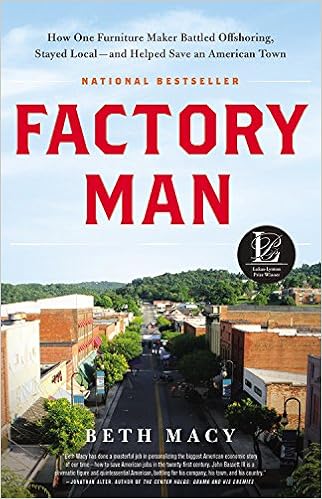
Factory Man: How One Furniture Maker Battled Offshoring, Stayed Local - and Helped Save an American Town, by Beth Macy

Get Free Ebook Factory Man: How One Furniture Maker Battled Offshoring, Stayed Local - and Helped Save an American Town, by Beth Macy
What sort of entertainment publication that you will consider accompanying your holiday time in your vacation? Is that the fiction book or novel or literary book or the factual publication? Everybody has various taste to set as the enjoyable or enjoyment publication for checking out some may think that the one that can amuse is the book that uses the enjoyable thing and also its fiction. Yet, some likewise find that they will enjoy the accurate book as enjoyment to satisfy the leisure time.
When initially opening this publication to read, also in soft file system, you will see how guide is developed. From the cove we will certainly also discover that the author is actually fantastic in making the viewers really feel brought in to read more and also much more. Ending up one page will lead you to read next web page, and also additionally. This is why Factory Man: How One Furniture Maker Battled Offshoring, Stayed Local - And Helped Save An American Town, By Beth Macy has many followers. This is exactly what the author clarifies to the readers as well as says the significance
Associated with why this Factory Man: How One Furniture Maker Battled Offshoring, Stayed Local - And Helped Save An American Town, By Beth Macy is presented initially right here is that this referred publication is the one that you are trying to find, typically aren't you? Several are also same with you. They likewise seek for this great book as one of the sources to review today. The referred publication in this kind is mosting likely to provide the choice of knowledge to obtain. It is not just the specific society but also for the general public. This is why, you need to happen in gathering all lessons, as well as details concerning exactly what this book has been composed.
Locate the Factory Man: How One Furniture Maker Battled Offshoring, Stayed Local - And Helped Save An American Town, By Beth Macy in this site based on the web link that we have provided. Obviously, it will certainly be in soft file, yet by doing this can relieve you to obtain as well as utilize this book. This intriguing book is already concerned to the kind of easy publication creating with eye-catching topic to check out. Besides, exactly how they make the cover is extremely smart. It readies concept to see exactly how this publication attracts the readers. It will certainly likewise see exactly how the viewers will certainly choose this publication to go along with while spare time. Let's check and be just one of the people who get this book.
Review
A New York Times Notable Book of 2014 One of Janet Maslin's Top 10 Books of 2014 in the New York Times One of The Christian Science Monitor's Top 10 Nonfiction Books of 2014 One of Publishers Weekly Best Books of 2014: Nonfiction A Goodreads Choice Awards Finalist: Business "In a class with other runaway debuts like Laura Hillenbrand's "Seabiscuit" and Katherine Boo's "Behind the Beautiful Forevers": These nonfiction narratives are more stirring and dramatic than most novels. And Ms. Macy writes so vigorously that she hooks you instantly. You won't be putting this book down."―Janet Maslin, New York Times"Nonfiction storytelling at its finest.... It does what the best business books should: It delivers a heavily researched, highly entertaining story, at the end of which you realize you've learned something.... This is a great American story, the kind that we don't read often enough."―Bryan Burrough, New York Times"A truly remarkable work of researched narrative nonfiction, one the probes every corner of its topic and values every subject who has something to say.... Factory Man does justice to every hidden corner of the story. It's a book that leaves you feeling better for having read it."―Lucas Mann, San Francisco Chronicle"In a world of blue-collar victims, where logging chains seal forever the doors of mills and factories from the Rust Belt to the Deep South, Beth Macy's award-winning look at one furniture maker's refusal to give in is a breath of hope-and a damn fine story to read. The book tracks John Bassett's fight to keep American jobs on this side of borders and oceans, and keeps one American town from becoming a place of empty storefronts and FOR SALE signs."―Rick Bragg, Pulitzer Prize-winning author of The Most They Ever Had"Beth Macy has done a masterful job in personalizing the biggest American economic story of our time--how to save American jobs in the 21st Century. John Bassett III is a cinematic figure and quintessential American, battling for his company, his town and his country."―Jonathan Alter, author of The Center Holds: Obama and His Enemies"The author's brightly written, richly detailed narrative not only illuminates globalization and the issue of offshoring, but succeeds brilliantly in conveying the human costs borne by low-income people displaced from a way of life.... A masterly feat of reporting."―Kirkus (starred review)"Macy chronicles Bassett's saga with vigor, integrity, soul, and skill, offering a humdinger of a globalization story and a true drama that reads like a novel."―Christian Science Monitor"Macy's down-to-earth writing style and abundance of personal stories from manufacturing's beleaguered front lines make her work a stirring critique of globalization."―Carl Hays, Booklist"Macy's riveting narrative is rich in local color.... Vivid reporting."―Publishers Weekly (starred review)"The unlikely hero of Factory Man is a determined, ornery, and absolutely indomitable...business man. He's the head of a family furniture company and damned if he's going to be pushed around. Beth Macy has given us an inspiring and engaging tale for our times, but not the expected one."―Alex Jones, Pulitzer Prize-winning author of Losing the News: The Future of the News that Feeds Democracy, Director of the Shorenstein Center on Media, Politics and Public Policy and Laurence M. Lombard Lecturer in the Press and Public Policy
Read more
About the Author
Beth Macy won the J. Anthony Lukas Work-in-Progress Award, a joint project of the Columbia University Graduate School of Journalism and the Nieman Foundation for Journalism at Harvard for "her extraordinary reporting and narrative skills" and her work on Factory Man. The daughter of a factory worker, she writes about outsiders and underdogs. Her articles have appeared in national magazines and the Roanoke Times, where her reporting has won more than a dozen national awards, including a Nieman Fellowship at Harvard. She lives in Roanoke, Virginia.
Read more
Product details
Hardcover: 464 pages
Publisher: Little, Brown and Company; Later Printing edition (July 15, 2014)
Language: English
ISBN-10: 0316231436
ISBN-13: 978-0316231435
Product Dimensions:
6.4 x 1.5 x 9.5 inches
Shipping Weight: 1.6 pounds (View shipping rates and policies)
Average Customer Review:
4.5 out of 5 stars
414 customer reviews
Amazon Best Sellers Rank:
#347,122 in Books (See Top 100 in Books)
This book has received some very good press, including Janet Maslin's review in the NY Times, but it's not as advertised and not what it's cracked up to be. First, the advertising (including on the covers and the flyleaves) makes it sound as though the book is about one man taking on the Chinese government to save an industry. There is some of that, but you don't get to it until the last third of the book, and even then it's really more about the man than the battle with China. And the part about the man is really little more than hero worship, even if the hero is sometimes difficult and cantankerous and off-putting - kind of a lovable John McCain. And because she admires the man so much ("with all his faults she loves him still"), she injects herself into the story way too much, so in some ways it's really all about her.The first two-thirds of the book is a family saga, the family in question being the Bassetts of furniture fame, and there is lots of family gossip that has little or nothing to do with the stated subject of the book. It's interesting reading, and because it's not all about Ms. Macy and her reverence for Mr. Bassett III, it's better in some ways than the part of the book dealing with the stated subject. She also ends the book with a sort of wrap-up of the family saga and the fact that III rose above it. I suppose he may be worth of the praise, but I prefer a bit of distance between the author and her subject, and it just doesn't happen here.
I read about this book in the "New York Times" a week or so ago and downloaded it this morning. It sounded like it shared some characteristics with other books I have enjoyed that explain some of the economic characteristics of different products and put them in a global context - books like "Extra Virgin" (about olive oil) and "Travels of a T-Shirt in the Global Economy". I told myself I'd read the first chapter this morning, then put it down until tonight.I emerged six hours later.My god, this book is AMAZING. Everyone who cares about communities, or about the economy, must read it. It makes me want to question every decision we make about trade agreements, retail purchases, federal subsidies, labor laws, and tax policy. Thank heavens for Bassett, who didn't drink the Koolaid - and for Beth Macy, who has managed to humanize modern global economics and make it understandable for everyone.
When I first read about and heard about this book, I was sure I wanted to read it. I live in Southside Virginia. Before I moved here, DuPont and Tultex had closed. Since I’ve lived here, I’ve seen the closings of all the major companies that made this area the manufacturing powerhouse it was. Now that’ve read the book, I would highly recommend it as an explanation for how American jobs were handed over to foreign interests. We rolled over and played dead.The really good parts: Beth Macy did an excellent job of going step-by-step through what happened to the furniture industry that built this area, both in its heyday and in its capitulation to Asian manufacturing. Finally, someone talked about the out-sourcing of American jobs remembering the people who were hurt by them. These are people who will never have a job that good again before they retire. They were trained for factory work that doesn’t exist anymore. If they want a job that pays almost as well as the one they lost, they have to leave the area. Thousands already have. If other Americans think it isn’t coming to their towns, they’re wrong.Ms. Macy rightfully takes to task the economists in their ivory towers. They talk about the consumer getting a better deal by having cheaper products available to them. This kind of short-sighted thinking does not consider a major factor in this equation—consumers have to have jobs in order to consume. No job, no buying the cheap products that put them out of work. No buying, slow economy that takes a long time to recover. This ought to sound familiar to anyone listening to economic news these days.Even more telling was the comment made by the Asian who marveled that American capitalists would do anything for a buck, including give away their manufacturing knowledge and jobs. He said once they had these things, they wouldn’t be stupid enough to give them up.I appreciated her declaring at the beginning of the book her own biases—she was the daughter of factory workers in Ohio and had seen her own parents put out of work when the jobs were taken somewhere else. She acknowledged that she liked some of the main characters in the book more than others, including her admiration for John D. Bassett, III, the book’s main character. She pointedly remembered the folks others wouldn’t have remembered—the factory workers, especially the black ones, and the domestic workers of the factory owners.My one and only complaint was at the beginning of the book, when she talks about the history of the extended Bassett family, she put in every piece of gossip she was told. Macy wrote that the curator of the Bassett Heritage Center told her to. However, I thought she should have exercised a little more judgment. Some pieces of extended family history were just hurtful to no particular end. Some details were tawdry and unnecessary.That said, I would highly recommend the rest of the book.
Factory Man: How One Furniture Maker Battled Offshoring, Stayed Local - and Helped Save an American Town, by Beth Macy PDF
Factory Man: How One Furniture Maker Battled Offshoring, Stayed Local - and Helped Save an American Town, by Beth Macy EPub
Factory Man: How One Furniture Maker Battled Offshoring, Stayed Local - and Helped Save an American Town, by Beth Macy Doc
Factory Man: How One Furniture Maker Battled Offshoring, Stayed Local - and Helped Save an American Town, by Beth Macy iBooks
Factory Man: How One Furniture Maker Battled Offshoring, Stayed Local - and Helped Save an American Town, by Beth Macy rtf
Factory Man: How One Furniture Maker Battled Offshoring, Stayed Local - and Helped Save an American Town, by Beth Macy Mobipocket
Factory Man: How One Furniture Maker Battled Offshoring, Stayed Local - and Helped Save an American Town, by Beth Macy Kindle


0 komentar:
Posting Komentar